If you’ve ever paused mid-sentence wondering whether to use underwent vs undergone, you’re not alone. These two words look similar, sound formal, and often confuse even confident English speakers. The key focus keyword here—underwent vs undergone—comes down to verb tense and grammar structure, not meaning.
Both words come from the verb “undergo,” which means to experience or be subjected to something, especially something difficult or important like surgery, training, or change. But the way they function in a sentence is very different.
Let’s break it down in a simple, practical way so you never mix them up again.
What Does “Undergo” Mean in Grammar?
Before comparing underwent vs undergone, it helps to understand the base verb.
Undergo means:
- To experience something
- To go through a process
- To be subjected to an event or condition
Examples of “undergo”:
- She will undergo surgery tomorrow.
- The building is undergoing renovation.
- He undergoes regular training.
Now, this verb changes depending on tense:
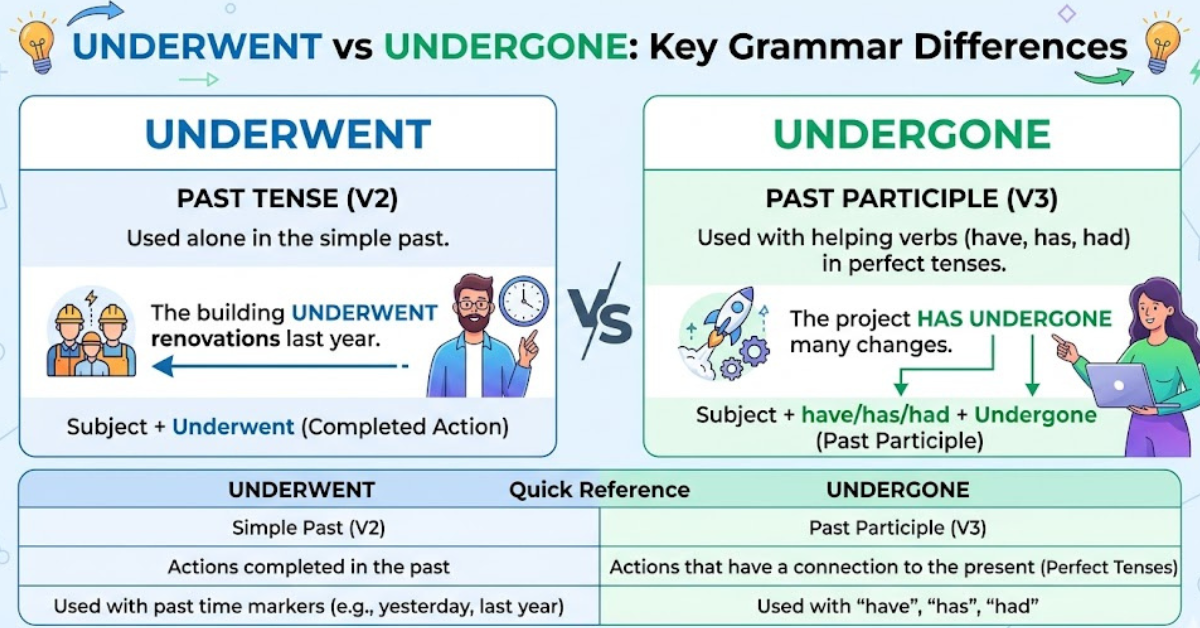
- Past simple → underwent
- Past participle → undergone
This is where confusion usually starts.
Underwent Meaning and Usage Past Simple
Underwent is the past simple form of “undergo.”
You use it when talking about something that already happened in the past and is complete.
Structure:
Subject + underwent + object
Examples of “underwent”:
- She underwent surgery last year.
- The company underwent major changes in 2020.
- He underwent intense training before the competition.
Key point:
Use underwent when there is no helping verb like has, have, or had.
Think of it as a “finished action in the past.”
Undergone Meaning and Usage Past Participle
Undergone is the past participle of “undergo.” It cannot stand alone in a sentence. It always needs a helping verb.
Common helping verbs:
- has
- have
- had
Structure:
Subject + has/have/had + undergone + object
Examples of “undergone”:
- She has undergone surgery.
- The city has undergone rapid development.
- They had undergone extensive training before the event.
Key point:
Use undergone when forming:
- Present perfect tense
- Past perfect tense
- Passive-like constructions
Underwent vs Undergone: Quick Comparison
Here’s a simple breakdown to make it crystal clear:
| Word | Type | Tense Used | Example |
| Underwent | Past simple | Completed past | He underwent surgery. |
| Undergone | Past participle | Perfect tenses | He has undergone surgery. |
Common Mistakes with Underwent vs Undergone
Many learners mix them up in everyday writing. Here are the most common errors:
1. Wrong:
- She has underwent surgery.
Correct:
- She has undergone surgery.
2. Wrong:
- He undergone training yesterday.
Correct:
- He underwent training yesterday.
3. Wrong:
- The city has underwent changes.
Correct:
- The city has undergone changes.
Easy Trick to Remember the Difference
If you’re stuck between underwent vs undergone, use this simple rule:
- If there is NO helping verb → use underwent
- If there IS a helping verb (has/have/had) → use undergone
Memory shortcut:
- Went = standalone past
- Gone = needs helper verb
Since “underwent” behaves like “went,” and “undergone” behaves like “gone,” the pattern becomes easier to remember.
Real-Life Usage Examples
Medical Context:
- The patient underwent surgery successfully.
- The patient has undergone surgery and is recovering.
Business Context:
- The company underwent restructuring.
- The company has undergone restructuring multiple times.
Personal Growth:
- He underwent a major transformation.
- He has undergone significant personal change.
Why People Confuse Underwent and Undergone
The confusion mainly happens because:
- Both come from the same base verb (undergo)
- Both refer to past experiences
- Both are used in formal English
However, grammar rules—not meaning—decide which one is correct.
Once you understand tense structure, the confusion disappears.
FAQs: Underwent vs Undergone
1. What is the difference between underwent and undergone?
Underwent is past simple, while undergone is the past participle used with helping verbs like has/have/had.
2. Can I say “has underwent”?
No. The correct form is “has undergone.”
3. Is “undergone” past or present?
“Undergone” is a past participle used in perfect tenses, not a standalone past tense form.
4. When should I use underwent?
Use underwent when describing a completed action in the past without helping verbs.
5. Which is more formal: underwent or undergone?
Both are formal, but undergone appears more often in academic and professional writing due to perfect tense usage.
Conclusion: Mastering Underwent vs Undergone
Understanding underwent vs undergone is really about mastering verb structure rather than memorizing vocabulary. If you remember one simple rule—underwent is past simple, and undergone needs a helping verb—you’ll avoid most common mistakes.
The next time you write about surgery, transformation, or change, you’ll know exactly which form fits your sentence.
If you want to improve your grammar further, explore related topics like irregular verbs, past participles, and tense structures—they all connect back to this same foundation.