
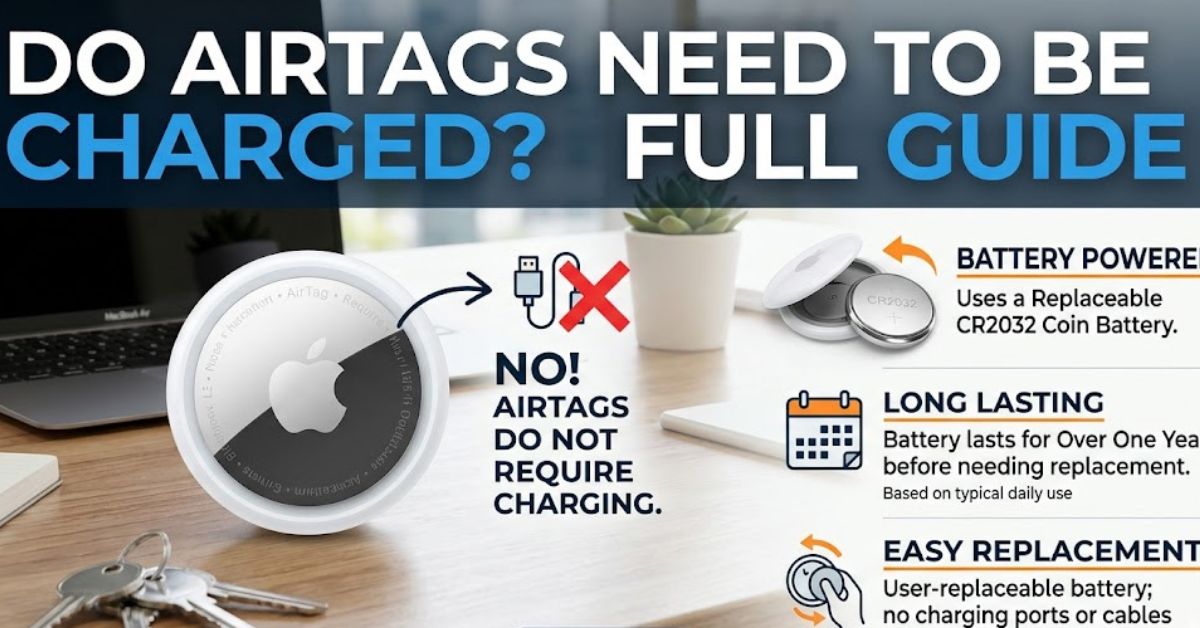
You’ve probably heard of Apple AirTags being used to track keys, bags, or even luggage—but one question comes up again and again: do AirTags need to be charged?
It’s a fair question, especially since most modern gadgets rely on rechargeable batteries. When you first set up an AirTag, it feels like just another smart device you’ll need to plug in regularly. But Apple designed it very differently.
In this guide, we’ll clearly explain whether do AirTags need to be charged, how their power system actually works, how long they last, and what you need to do when the battery runs low. You’ll also get practical tips and common mistakes to avoid.
What Are Apple AirTags?
Apple AirTags are small tracking devices designed to help you locate personal items using the Find My network. They connect to your iPhone, iPad, or Mac using Bluetooth and ultra-wideband technology (on supported devices).
Common uses include:
- Tracking keys and wallets
- Locating backpacks or luggage
- Keeping tabs on bikes or small valuables
Despite their smart features, AirTags are surprisingly simple when it comes to power.
Do AirTags Need to Be Charged or Replaced?
Let’s answer the main question directly: do AirTags need to be charged?
No, AirTags do not need to be charged at all.
Unlike smartphones, smartwatches, or earbuds, Apple AirTags do not have a rechargeable battery or charging port. Instead, they use a replaceable coin-cell battery.
So when people ask, do AirTags need to be charged, the correct answer is:
- They are not rechargeable
- You don’t plug them in
- You simply replace the battery when it runs out
This makes them low-maintenance and extremely convenient for long-term use.
How AirTags Get Their Power
Instead of lithium-ion rechargeable batteries, AirTags use a CR2032 coin cell battery.
Key Facts About the Battery:
- Standard 3-volt lithium coin battery
- Widely available in stores and online
- Easy to replace by users
- No special tools required
Apple chose this design to keep AirTags lightweight and simple. So when considering do AirTags need to be charged, it’s important to understand they operate more like a traditional watch than a smart device.
AirTag Battery Life: How Long Does It Last?
One of the biggest advantages of AirTags is long battery life.
On average:
- Battery lasts about 10–14 months
- Depends on usage and tracking frequency
Factors that can affect battery life:
- How often the AirTag is pinged via Find My
- Use of Precision Finding (UWB on iPhone models)
- Environmental conditions (temperature extremes)
- Frequency of movement and tracking updates
Even with heavy use, most users won’t need to worry about battery replacement for nearly a year.
So again, when asking do AirTags need to be charged, the real takeaway is that charging is never part of the equation—only replacement.
How to Check AirTag Battery Level
Apple doesn’t show a precise percentage, but you can still monitor battery status easily.
On iPhone:
- Open the Find My app
- Tap Items
- Select your AirTag
- Look for the battery status indicator
When the battery gets low, your iPhone will automatically send a notification saying the battery is running out.
This helps ensure you never unexpectedly lose tracking functionality.
How to Replace an AirTag Battery
Since do AirTags need to be charged is a common misconception, here’s what you actually do when power runs out.
Steps to Replace the Battery:
- Press and rotate the stainless steel back counterclockwise
- Remove the old CR2032 battery
- Insert a new CR2032 battery (positive side up)
- Close and twist back into place
That’s it—your AirTag is instantly powered again.
No syncing or setup required.
Tips to Extend AirTag Battery Life
Even though you don’t charge AirTags, you can still make the battery last longer.
Practical tips:
- Avoid unnecessary pings in Find My
- Keep AirTag updated via iOS updates
- Store unused AirTags in moderate temperatures
- Use quality CR2032 batteries (some cheap ones drain faster)
These small habits can extend overall performance, even if do AirTags need to be charged is not relevant in the traditional sense.
Common Misconceptions About AirTag Power
Many users assume AirTags work like AirPods or Apple Watch. Let’s clear that up.
Misunderstandings:
- They are rechargeable
- They come with charging cables
- They need daily charging
Reality:
- They use replaceable coin batteries
- They last up to a year
- No charging ever required
So if you were still wondering do AirTags need to be charged, the confusion usually comes from assuming all Apple devices are rechargeable.
Real-World Use Case
Imagine you attach an AirTag to your suitcase before a flight. You travel across multiple countries for 10 months. During this entire period:
- You never charge it
- You never open it
- It silently works in the background
Eventually, your phone notifies you that the battery is low. You replace it in under a minute, and it continues working.
That’s the simplicity Apple aimed for.
Key Takeaways
- AirTags do NOT require charging
- They use replaceable CR2032 coin batteries
- Battery life lasts around 1 year
- Your iPhone alerts you when battery is low
- Replacement is quick and tool-free
FAQs
1. Do AirTags need to be charged like AirPods?
No, AirTags do not need charging. They use a replaceable CR2032 battery instead of a rechargeable system.
2. How often do I need to replace an AirTag battery?
On average, once every 10–14 months depending on usage. Heavy tracking may shorten battery life slightly.
3. Can I recharge an AirTag battery?
No, the battery inside an AirTag is not rechargeable. You must replace it when it runs out.
4. How do I know if my AirTag battery is low?
Your iPhone will notify you through the Find My app when the battery is getting low.
5. What battery does an AirTag use?
AirTags use a standard CR2032 lithium coin cell battery, widely available in stores.
6. Why don’t AirTags need charging?
Apple designed them for ultra-low power usage, allowing them to run efficiently for months on a small replaceable battery.
Conclusion
So, do AirTags need to be charged? The answer is simple: no charging is ever required. Apple designed AirTags to run on long-lasting, replaceable CR2032 batteries, making them one of the most low-maintenance tracking devices available today.
Instead of worrying about cables or charging routines, you simply replace the battery once a year and keep going. That simplicity is exactly what makes AirTags so practical for everyday tracking.
If you’re exploring Apple accessories, understanding how AirTags power themselves helps you get the most out of them without unnecessary confusion.