
Every English sentence revolves around a verb, but not all verbs appear in the same form. Whether you’re learning grammar, improving your writing, or preparing for exams, understanding the base form of verb is essential. It serves as the foundation from which all other verb forms are created.
In this guide, you’ll learn what the base form of verb means, why it’s important, how it differs from other verb forms, and how to use it correctly with practical examples. By the end, you’ll have a clear understanding of one of the most fundamental concepts in English grammar.
What Is the Base Form of Verb?
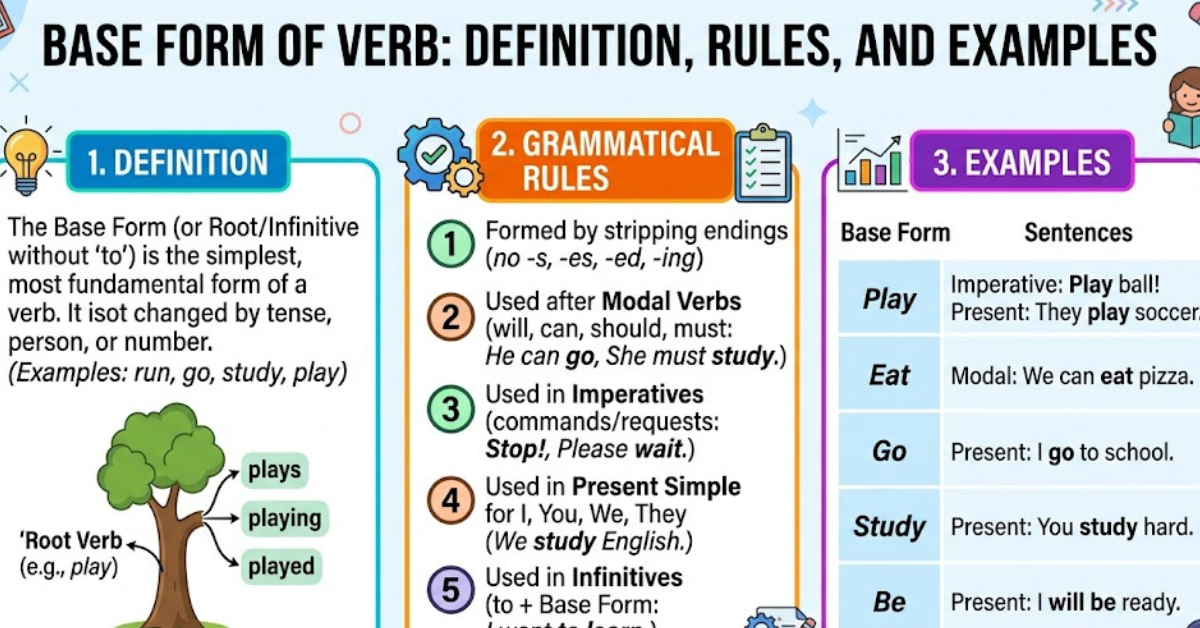
The base form of verb is the simplest form of a verb without any endings or modifications. It is the form you would find listed in a dictionary.
Examples of Base Verbs
| Base Form | Meaning |
| Go | Move from one place to another |
| Eat | Consume food |
| Write | Create text |
| Play | Participate in a game or activity |
| Run | Move quickly on foot |
These verbs can change depending on tense, person, or grammatical context, but their original version remains the base form.
Why Is the Base Form of Verb Important?
The base form acts as the root from which other verb forms are derived. Understanding it helps with:
- Forming different tenses
- Creating infinitives
- Using modal verbs correctly
- Improving sentence construction
- Learning English grammar more effectively
For example:
- Base Form: Write
- Past Tense: Wrote
- Past Participle: Written
- Present Participle: Writing
Without knowing the base form, mastering these variations becomes much harder.
How to Identify the Base Form of a Verb
Finding the base form is usually straightforward. Remove any tense endings or grammatical modifications and return the verb to its simplest form.
Examples
| Verb Form | Base Form |
| Running | Run |
| Played | Play |
| Eats | Eat |
| Written | Write |
| Drove | Drive |
A useful trick is to imagine the verb following the word “to.”
Examples:
- To run
- To eat
- To write
The word after “to” is generally the base form.
Base Form vs Other Verb Forms
Understanding the differences between verb forms can prevent common grammar mistakes.
Base Form
The original form of the verb.
Examples:
- Eat
- Jump
- Read
Third-Person Singular Form
Used with he, she, or it in the simple present tense.
Examples:
- Eats
- Jumps
- Reads
Past Tense Form
Shows actions completed in the past.
Examples:
- Ate
- Jumped
- Read
Present Participle
Usually ends in “-ing.”
Examples:
- Eating
- Jumping
- Reading
Past Participle
Often used with helping verbs.
Examples:
- Eaten
- Jumped
- Read
When to Use the Base Form of Verb
The base form appears in several important grammar situations.
1. After Modal Verbs
Modal verbs always take the base form.
Examples:
- I can swim.
- She may come.
- They should study.
Incorrect:
- She can goes.
Correct:
- She can go.
2. In Imperative Sentences
Commands and instructions use the base form.
Examples:
- Sit down.
- Open the door.
- Read the instructions carefully.
3. With the Infinitive Marker “To”
The infinitive consists of “to” plus the base form.
Examples:
- To learn
- To travel
- To speak
Sentence examples:
- I want to learn English.
- She hopes to travel abroad.
4. In Simple Present Tense
The base form is used with most subjects.
Examples:
- I work every day.
- You play football.
- We study together.
Exception:
For he, she, and it, the verb usually takes an “-s” ending.
- He works.
- She plays.
Common Examples of Base Verbs
Here are some frequently used base verbs in English:
Action Verbs
- Walk
- Run
- Jump
- Dance
- Sing
Mental Verbs
- Think
- Know
- Remember
- Understand
- Believe
Linking Verbs
- Be
- Become
- Seem
- Appear
- Remain
Regular and Irregular Verbs
Regular Verbs
Regular verbs follow predictable patterns when changing tense.
Examples:
| Base Form | Past Tense |
| Walk | Walked |
| Talk | Talked |
| Work | Worked |
Irregular Verbs
Irregular verbs change differently.
Examples:
| Verify | Confirm |
| Checks accuracy through evidence | Validates or acknowledges information |
| Requires investigation | Requires assurance or agreement |
| Focuses on proving facts | Focuses on establishing certainty |
| Often occurs before acceptance | Often occurs after initial information is received |
Learning the base form makes it easier to memorize irregular verb patterns.
Common Mistakes with the Base Form of Verb
Many English learners make similar errors.
Mistake 1: Using the Wrong Form After Modal Verbs
Incorrect:
- I can driving.
Correct:
- I can drive.
Mistake 2: Adding Unnecessary Endings
Incorrect:
- She should studies.
Correct:
- She should study.
Mistake 3: Confusing Infinitives and Conjugated Forms
Incorrect:
- I want goes home.
Correct:
- I want to go home.
Tips for Mastering the Base Form of Verb
Follow these strategies to improve your grammar skills:
- Learn verbs in their dictionary form.
- Practice creating verb tables.
- Read English books and articles regularly.
- Pay attention to modal verb structures.
- Write simple sentences using base verbs daily.
- Memorize common irregular verbs.
Consistent practice helps you recognize the correct form automatically.
Examples of Base Form of Verb in Sentences
Here are practical examples showing the base form in action:
- I can drive a car.
- Please close the window.
- They want to travel next year.
- We study English every evening.
- You should listen carefully.
Notice how the base form remains unchanged in each sentence.
FAQ About the Base Form of Verb
What is the base form of a verb?
The base form of a verb is its simplest form without tense markers, endings, or modifications. Examples include go, eat, write, and play.
Is the base form the same as an infinitive?
Not exactly. The infinitive includes the word “to” plus the base form, such as “to eat” or “to write.”
Why is the base form important in grammar?
It serves as the foundation for creating different tenses, participles, and grammatical structures in English.
What is the base form of “running”?
The base form of “running” is run.
Do modal verbs use the base form?
Yes. Modal verbs such as can, should, may, and must are always followed by the base form of a verb.
Is “be” a base form?
Yes. “Be” is the base form of the verb that appears as am, is, are, was, and were in different contexts.
Conclusion
The base form of verb is one of the most important building blocks of English grammar. It represents the original form of a verb and serves as the starting point for creating tenses, infinitives, participles, and other verb structures. Understanding when and how to use the base form can significantly improve your writing, speaking, and overall language accuracy.
As you continue learning English, practice identifying base verbs in everyday sentences and pay attention to how they change in different grammatical situations. Building a strong foundation with the base form of verb will make mastering English grammar much easier and more enjoyable.