
Have you ever heard someone say “I’ll see you in a fortnight” and wondered exactly how long that really is? It’s one of those old-school time terms that still pops up, especially in British English. But when you start thinking in bigger terms, a natural question comes up: how many fortnights in a year?
In simple terms, a fortnight equals 14 days, or two weeks. So when we break it down across an entire year, things get a little more interesting than a neat, round number. In this guide, we’ll explore how many fortnights in a year, how the calculation works, why it’s not exact, and where this unit of time is still used today.
What Is a Fortnight? Understanding the Basics
A fortnight simply means a period of 14 days. The word comes from Old English “fēowertīene niht,” meaning “fourteen nights.”
Why people still use it
Even though modern calendars rely on weeks and months, the term survives in:
- UK and Irish English conversations
- Work schedules (especially pay cycles)
- Historical or literary contexts
So when someone mentions a fortnight, they’re referring to exactly two weeks.
How Many Fortnights in a Year (The Simple Math)
To understand how many fortnights in a year, we start with basic calendar math:
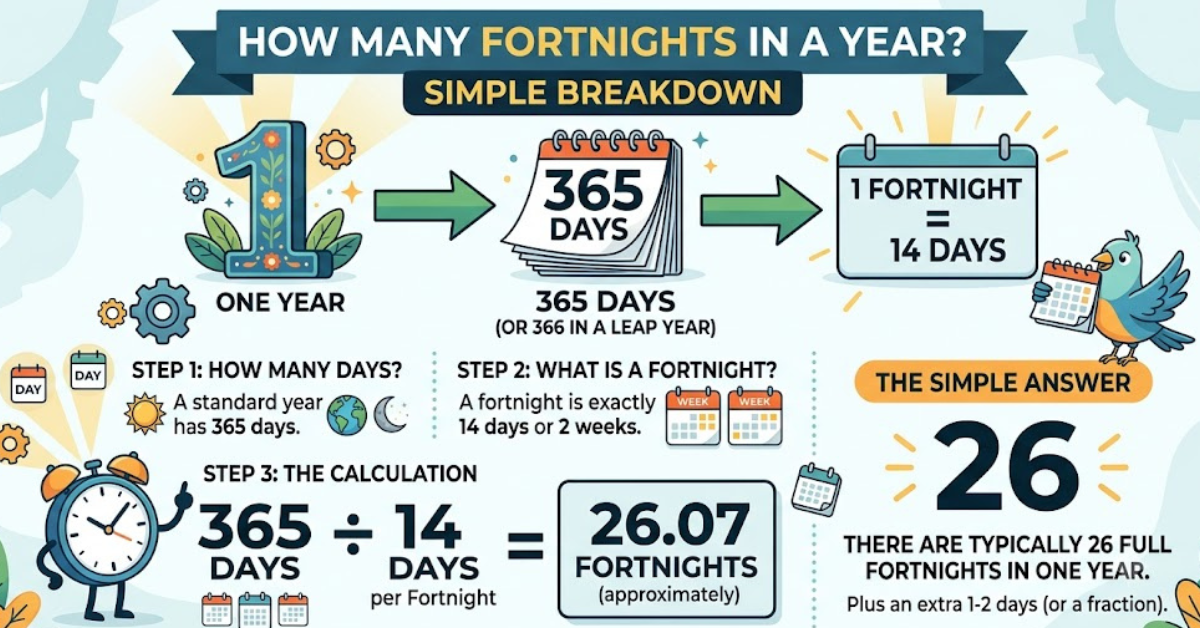
- 1 year = 365 days (non-leap year)
- 1 fortnight = 14 days
Now divide:
365 ÷ 14 = 26.07 fortnights
So, the direct answer to how many fortnights in a year is approximately 26 fortnights, with a small leftover of days.
In a leap year:
- 366 ÷ 14 = 26.14 fortnights
Still not a whole number, which is where things get interesting.
Why a Year Doesn’t Divide Evenly into Fortnights
The reason how many fortnights in a year never gives a clean number is because:
1. A year isn’t evenly divisible by 14
A solar year is based on Earth’s orbit (365.24 days), not neat calendar blocks.
2. Extra days always remain
After 26 full fortnights:
- You’re left with about 1–2 days each year
3. Calendar systems are based on weeks and months
Weeks (7 days) and months (28–31 days) don’t align perfectly either.
So, while we often say “about 26 fortnights,” it’s always an approximation.
Fortnights vs Weeks: A Quick Comparison
To better understand how many fortnights in a year, it helps to compare:
- 1 fortnight = 2 weeks
- 1 year = 52 weeks
- 52 weeks ÷ 2 = 26 fortnights
This is why people often round the answer to 26—it comes from the weekly structure rather than exact day counts.
Real-World Use of Fortnights Today
Even though it’s not part of modern official calendars in most countries, the concept of a fortnight is still practical.
Common uses include:
- Salary schedules (biweekly pay equals one fortnight)
- Project timelines
- Rental agreements in some regions
- Academic or training schedules
So when you ask how many fortnights in a year, you’re also indirectly exploring how many biweekly cycles fit into annual planning—around 26 cycles.
Practical Insight: What 26 Fortnights Look Like
If you divide your year into fortnights, you essentially get:
- 26 full two-week cycles
- Plus 1 extra day (or 2 in leap years)
This breakdown is useful for:
- Budget planning
- Fitness or habit tracking
- Business reporting cycles
So understanding how many fortnights in a year can actually help with organizing long-term goals.
Key Takeaways
- A fortnight = 14 days (2 weeks)
- A year contains about 26 fortnights
- The exact number is 26.07 (non-leap year)
- Small leftover days prevent a perfect division
- Fortnights are still useful in finance, work, and planning
FAQs
1. How many fortnights in a year exactly?
There are about 26 fortnights in a year, with a small remainder of days depending on leap years.
2. Is a fortnight always 14 days?
Yes, a fortnight always equals 14 consecutive days or two weeks.
3. Why do people ask how many fortnight in a year?
It helps in planning schedules, especially for biweekly pay, routines, and project timelines.
4. Is 26 fortnights in a year exact?
Not exactly. A year is slightly longer than 26 fortnights, leaving extra hours and days.
5. How many fortnights in a leap year?
A leap year has about 26.14 fortnights, still not a whole number.
6. Is the term “fortnight” still used today?
Yes, mainly in British English and in formal or traditional contexts like scheduling and payroll.
Conclusion
So, when you break it down, the answer to how many fortnights in a year is roughly 26, though the real number is slightly higher due to extra days in the calendar. While it may seem like an old-fashioned term, fortnights still have practical value in planning, finance, and time management.
If anything, understanding how many fortnights in a year gives you a fresh way to look at time—not just in months or weeks, but in simple two-week cycles that are easy to work with in everyday life.