
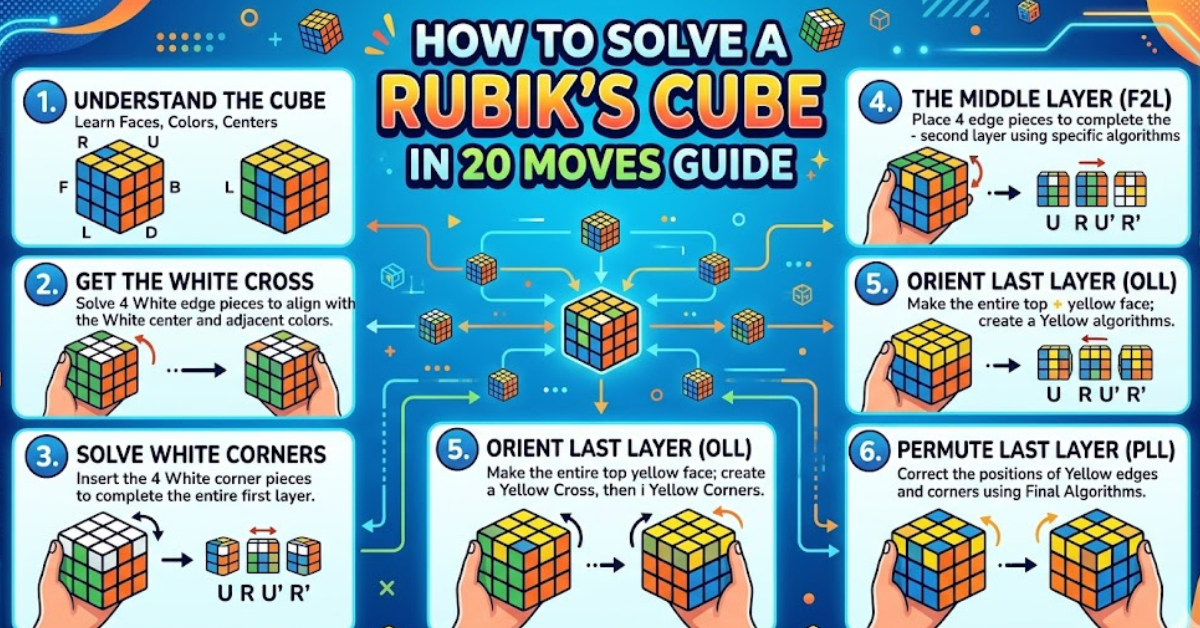
Ever scrambled a Rubik’s Cube and wondered if there’s a “perfect shortcut” to solve it in just a handful of moves? That curiosity is exactly what makes the idea of how to solve a Rubik’s Cube in 20 moves so fascinating. It sounds almost impossible—like a puzzle myth—but behind it lies real mathematics, computer algorithms, and decades of research.
In this guide, you’ll learn what those 20 moves actually mean, whether humans can really achieve them, and how experts and computers approach optimal cube solving.
What Does “20 Moves” Really Mean?
When people talk about how to solve a Rubik’s Cube in 20 moves, they’re usually referring to a mathematical discovery known as God’s Number.
God’s Number is the maximum number of moves required to solve any scrambled Rubik’s Cube position, using the most efficient possible solution.
- In the quarter-turn metric (QTM), the number is 20
- This was proven in 2010 using massive computer computation
- It means any cube position can be solved in 20 moves or fewer—at least theoretically
So, 20 moves isn’t a trick—it’s a boundary of mathematical perfection.
Can You Really Solve a Rubik’s Cube in 20 Moves?
Here’s the honest answer: yes, but not manually in the way most people solve a cube.
For a human, solving a cube in 20 moves requires:
- Advanced algorithms beyond beginner methods
- Knowledge of optimal solving theory
- Or the use of computer-assisted solving tools
So when we talk about how to solve a Rubik’s Cube in 20 moves, we’re usually entering the world of:
- Computer solvers
- Mathematical optimization
- Algorithmic solving (not intuitive layer-by-layer methods)
The Math Behind Optimal Cube Solving
Rubik’s Cube is not just a toy—it’s a group theory problem in mathematics. Every twist represents a permutation in a finite group with over 43 quintillion possible states.
To solve it optimally, researchers use:
- God’s Number (20 moves max in QTM)
- Algorithmic search methods
- Heuristic pruning techniques
- Pattern databases
This is where solving becomes less about intuition and more about computation.
How Computers Solve the Cube in 20 Moves
When computers tackle how to solve a Rubik’s Cube in 20 moves, they don’t “think” like humans. Instead, they explore huge decision trees.
The Kociemba Algorithm
One of the most famous methods is the Kociemba Two-Phase Algorithm:
Phase 1:
- Reduce the cube into a simpler subgroup
- Align edges and corners into solvable structure
Phase 2:
- Solve the simplified state optimally
- Search for shortest possible move sequences
This method doesn’t always guarantee exactly 20 moves, but it often produces very close-to-optimal solutions.
Computer Solvers in Action
To achieve how to solve a Rubik’s Cube in 20 moves, programs typically:
- Use IDA* search (Iterative Deepening A*)
- Apply pruning tables to eliminate bad moves
- Precompute billions of cube states
- Test millions of possibilities per second
This is why computers, not humans, are responsible for proving the 20-move limit.
Why Humans Don’t Solve It This Way
Most human solving methods—like CFOP (Cross, F2L, OLL, PLL)—are designed for speed and memorization, not optimality.
A speedcuber:
- Uses 50–60+ moves on average
- Prioritizes recognition speed over move efficiency
So even advanced cubers don’t typically aim for how to solve a Rubik’s Cube in 20 moves in real time solving.
Instead, they aim for:
- Sub-10 second solves
- Efficient finger tricks
- Predictable algorithms
Practical Ways to Get Close to 20 Moves
While you won’t reliably hit the theoretical limit, you can improve efficiency:
1. Learn Advanced Algorithms
- CFOP (Fridrich method)
- Roux method
- ZZ method
2. Reduce “Waste Moves”
- Avoid unnecessary cube rotations
- Plan ahead instead of reacting
3. Study Optimal Solves
- Analyze computer-generated solutions
- Observe move cancellation patterns
These habits bring you closer to understanding how to solve a Rubik’s Cube in 20 moves, even if you don’t fully reach it.
Key Takeaways
- “20 moves” refers to God’s Number, not a human speed goal
- Every Rubik’s Cube position can be solved in ≤20 moves (theoretically)
- Computers, not humans, discovered and use this limit
- Human solving focuses on speed, not optimal move count
- Algorithms like Kociemba make near-optimal solutions possible
FAQs
1. What is the meaning of how to solve a Rubik’s Cube in 20 moves?
It refers to the mathematical proof that any cube can be solved in 20 moves or fewer using the most optimal solution.
2. Can a human actually solve a Rubik’s Cube in 20 moves?
Not reliably. Humans typically use longer, practical methods rather than optimal mathematical solutions.
3. Who discovered the 20-move Rubik’s Cube solution?
Researchers and computer scientists proved it in 2010 using massive computational power and group theory.
4. Is there a trick to solving a Rubik’s Cube in 20 moves fast?
There’s no simple trick. It requires algorithms like Kociemba’s method or computer-generated solutions.
5. Why is 20 moves considered special?
It represents the upper bound (God’s Number) proving the cube’s optimal solving limit in quarter-turn metric.
6. What method is closest to how to solve a Rubik’s Cube in 20 moves?
The closest practical method is using computer-assisted solvers or learning advanced algorithms that minimize moves.
Conclusion
The idea of how to solve a Rubik’s Cube in 20 moves sits at the intersection of mathematics, computing, and puzzle-solving culture. While it’s not something most people can execute manually, it reveals something powerful: even a chaotic-looking puzzle has a strict mathematical limit.
If anything, understanding this makes the Rubik’s Cube less of a mystery and more of a beautifully structured system. Whether you’re a casual solver or an aspiring speedcuber, exploring these ideas can completely change how you see the cube—and how you approach solving it.
If you’re curious, the next step is diving into solving methods like CFOP or exploring cube-solving algorithms to see how close you can get to optimal solutions in practice.