
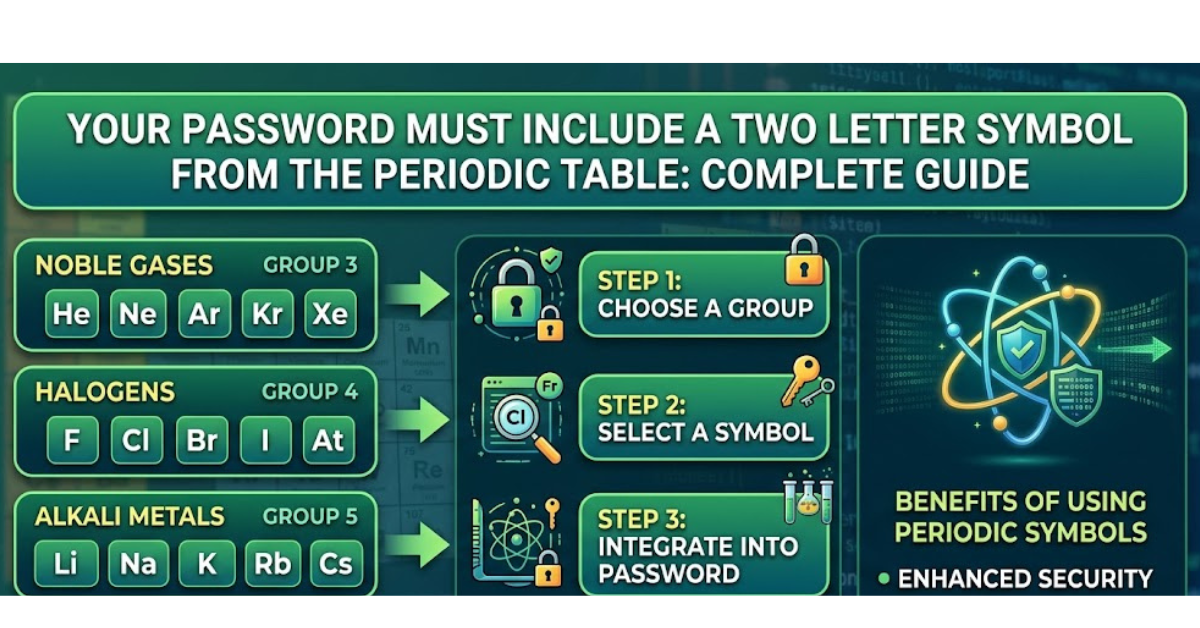
Have you ever been creating a password and suddenly encountered the message: “your password must include a two letter symbol from the periodic table”? At first glance, it may seem confusing, especially if you haven’t looked at a chemistry chart since school.
The good news is that this requirement is usually simple to satisfy. You only need to add the two-letter abbreviation of a chemical element, such as Fe for iron or Au for gold, into your password. In this guide, you’ll learn what this rule means, why it exists, examples of acceptable symbols, and how to create a strong password while meeting the requirement.
Understanding the Periodic Table Password Requirement
The periodic table is a scientific chart that organizes all known chemical elements. Each element has a unique chemical symbol, which can contain one or two letters.
When a website or game says your password must include a two letter symbol from the periodic table, it specifically requires a chemical element abbreviation made of exactly two letters.
For example:
- He – Helium
- Li – Lithium
- Ne – Neon
- Na – Sodium
- Mg – Magnesium
- Al – Aluminum
- Si – Silicon
- Cl – Chlorine
- Fe – Iron
- Cu – Copper
- Ag – Silver
- Au – Gold
Adding any one of these symbols can help satisfy the password rule.
What Counts as a Valid Two-Letter Element Symbol?
Not every pair of letters will work. The combination must match an officially recognized chemical symbol from the periodic table.
Rules for Element Symbols
Chemical symbols generally follow these formatting rules:
- The first letter is uppercase.
- The second letter is lowercase.
- The letters represent a real element.
- The symbol must be exactly two characters long.
For example:
Correct:
- Fe (Iron)
- Zn (Zinc)
- Kr (Krypton)
- Pb (Lead)
Incorrect:
- ABC (three letters)
- Xx (not a real element)
- H (only one letter)
- FE (may not work if the system requires proper capitalization)
Complete List of Common Two-Letter Periodic Table Symbols
Here are many of the two-letter symbols you can use:
Ac, Ag, Al, Am, Ar, As, At, Au
Ba, Be, Bh, Bi, Bk, Br
Ca, Cd, Ce, Cf, Cl, Cm, Cn, Co, Cr, Cs, Cu
Db, Ds, Dy
Er, Es, Eu
Fe, Fl, Fm, Fr
Ga, Gd, Ge
He, Hf, Hg, Ho, Hs
In, Ir
Kr
La, Li, Lr, Lu
Md, Mg, Mn, Mo, Mt
Na, Nb, Nd, Ne, Ni, No
Os
Pa, Pb, Pd, Pm, Po, Pr, Pt, Pu
Ra, Rb, Re, Rf, Rg, Rh, Rn, Ru
Sb, Sc, Se, Sg, Si, Sm, Sn, Sr
Ta, Tb, Tc, Te, Th, Ti, Tl, Tm, Ts
Xe
Yb
Zn, Zr
Any of these can fulfill the requirement if entered in the correct format.
Why Do Some Passwords Require a Periodic Table Symbol?
This unusual rule is commonly found in:
- Password-based puzzles
- Online games
- Educational challenges
- Creative security exercises
It is less common for standard websites like banking platforms or social media services, but some specialized systems may include unique password rules.
The goal is often to make passwords more complex or add a puzzle-like challenge.
Examples of Passwords That Meet the Requirement
Here are examples of passwords that include a two-letter chemical symbol:
- MountainFe2026!
- OceanAu#95
- TigerCl@Sun
- RocketNe88$
- WinterZn!Sky
Each example combines:
- A memorable word
- A periodic table symbol
- Numbers
- Special characters
This creates a password that is more difficult to guess.
Tips for Creating a Strong Password
Meeting a chemistry symbol requirement should not be the only focus. A secure password should also follow modern cybersecurity practices.
Use a Mix of Different Characters
Include:
- Uppercase and lowercase letters
- Numbers
- Special symbols like !, @, or #
Avoid Personal Information
Do not use:
- Birthdays
- Your name
- Phone numbers
- Simple patterns like “123456”
Make It Long and Unique
A password with 12–16 or more characters is generally much stronger than a short one.
Consider a Password Manager
Password managers can generate and securely store complex passwords, making it easier to use a different password for every account.
Key Takeaways
- A two-letter periodic table symbol is the abbreviation of a chemical element, such as Fe, Au, or Na.
- The first letter is usually uppercase, and the second is lowercase.
- There are over 100 chemical elements, and many have two-letter symbols.
- Adding an element symbol can help satisfy unusual password requirements.
- Always combine the symbol with other strong password practices.
Frequently Asked Questions
What does “your password must include a two letter symbol from the periodic table” mean?
It means your password needs to contain a valid two-letter chemical element symbol, such as Fe, Ag, or Ne, exactly as recognized on the periodic table.
Can I use any two letters as a periodic table symbol?
No. Only official element symbols are accepted. A random combination like “Xy” will not qualify because it is not a recognized chemical symbol.
Does capitalization matter for periodic table symbols in passwords?
In many cases, yes. Element symbols traditionally use a capital first letter followed by a lowercase second letter, such as “Au” or “Zn.”
What is the easiest two-letter periodic table symbol to remember?
Common choices include Fe (iron), Au (gold), Ag (silver), Na (sodium), and He (helium) because they are widely known and easy to recall.
Are periodic table symbols enough to make a password secure?
No. While they satisfy a specific rule, a strong password should also include length, unique phrases, numbers, and special characters.
How many two-letter element symbols are there?
Most chemical elements use two-letter symbols. The periodic table contains many valid options, giving you plenty of choices when meeting this password requirement.
Conclusion
Seeing the message “your password must include a two letter symbol from the periodic table” may initially feel like a difficult chemistry quiz, but it is actually a straightforward requirement. Simply include a valid element abbreviation like Fe, Au, He, or Zn in your password.
Remember that fulfilling the rule is only one part of good password security. Combine your chosen element symbol with a long, unique password that includes numbers and special characters. By understanding these simple rules, you can solve password challenges quickly while keeping your accounts better protected.