
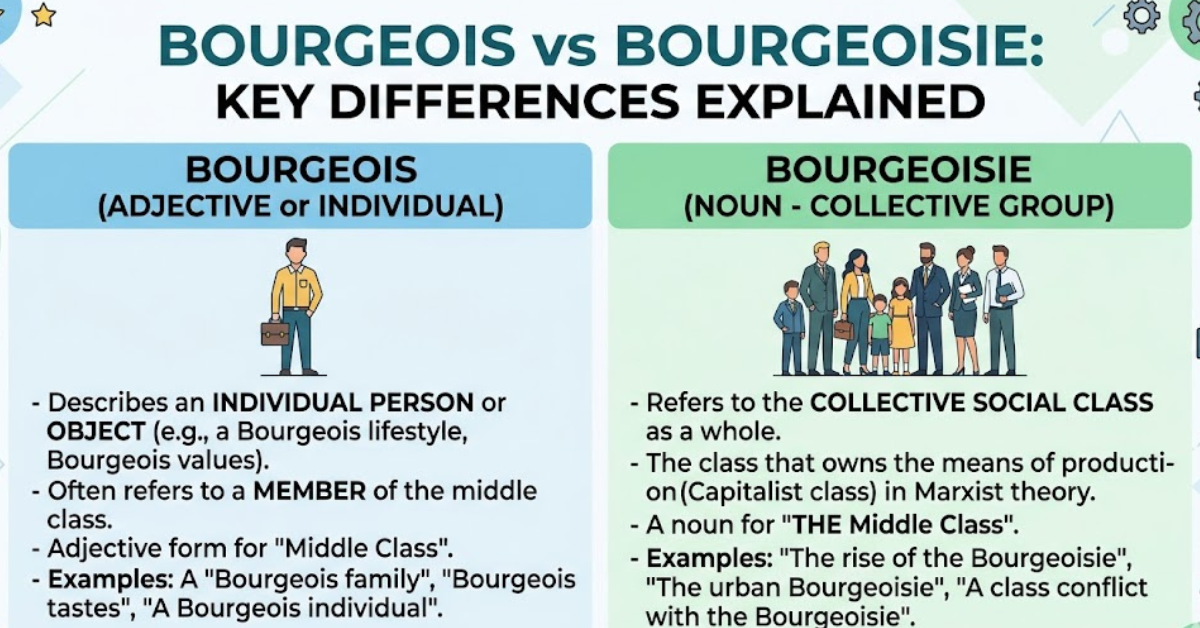
The confusion around bourgeois vs bourgeoisie is more common than you might think. These two words look similar, sound fancy, and often show up in discussions about society, economics, and politics—but they don’t mean the same thing.
At their core, the debate of bourgeois vs bourgeoisie comes down to one simple idea: one refers to a type of person or attitude, while the other refers to an entire social class. But there’s more depth to it, especially when you bring in history and Marxist theory.
Let’s break it down in a way that actually makes sense.
What Does “Bourgeois” Mean?
The word bourgeois can function as both an adjective and a noun, depending on how it’s used.
As a noun:
A bourgeois is typically an individual belonging to the middle or upper-middle class, especially someone focused on material wealth, comfort, and conventional values.
As an adjective:
It describes something that is considered materialistic, conventional, or overly concerned with social status.
Common traits associated with “bourgeois”:
- Preference for stability and routine
- Focus on property and financial success
- Conventional or traditional lifestyle choices
- Taste for “respectable” cultural norms
For example:
“He has very bourgeois tastes—fine dining, luxury cars, and designer clothes.”
What Is the Bourgeoisie?
The term bourgeoisie refers to a broader social class rather than an individual. It is most commonly used in Marxist theory and sociology.
Definition:
The bourgeoisie is the class that owns the means of production—factories, land, businesses, and capital.
In simpler terms, they are the property-owning class in a capitalist society.
Key characteristics of the bourgeoisie:
- Ownership of businesses and capital
- Control over economic production
- Influence over political and social systems
- Historically contrasted with the working class (proletariat)
In Marxist thought, the bourgeoisie plays a central role in shaping capitalism.
Bourgeois vs Bourgeoisie: Key Differences Explained
Understanding bourgeois vs bourgeoisie becomes easier when you compare them side by side.
1. Individual vs Class
- Bourgeois: A person or characteristic
- Bourgeoisie: A social class group
2. Usage in Language
- Bourgeois: Often used as an adjective in everyday speech
- Bourgeoisie: Mostly used in academic, historical, or political contexts
3. Focus of Meaning
- Bourgeois: Lifestyle, behavior, mindset
- Bourgeoisie: Economic power and ownership
4. Context
- Bourgeois: Social commentary or casual description
- Bourgeoisie: Sociology, economics, Marxism
Historical and Marxist Perspective
The distinction between bourgeois vs bourgeoisie became especially important during the rise of industrial capitalism in Europe.
Karl Marx and Friedrich Engels used the term bourgeoisie to describe the capitalist class that controlled industry and wealth. According to Marxist theory:
- The bourgeoisie owns production (factories, machines, capital)
- The proletariat sells labor to survive
Meanwhile, “bourgeois” behavior was often criticized as being self-interested or focused on maintaining social status rather than equality.
Modern Usage of Bourgeois vs Bourgeoisie
Today, the terms are used in both academic and casual ways, but with softer meanings.
In modern speech:
- “Bourgeois” can simply mean middle-class or conventional
- “Bourgeoisie” may refer to wealthy business owners or elites
Examples in modern context:
- “That neighborhood has a very bourgeois feel.”
- “The rise of the tech bourgeoisie has changed urban economies.”
Common Misunderstandings
People often mix up bourgeois vs bourgeoisie, but here’s what usually causes confusion:
- They come from the same French root (“bourgeois” = town dweller)
- They are used in overlapping discussions about class
- Both are tied to wealth and social status
However, remembering this distinction helps:
Bourgeois = individual or trait
Bourgeoisie = group or class
Quick Summary List
- Bourgeois → person, behavior, or lifestyle
- Bourgeoisie → economic and social class
- Bourgeois = descriptive term
- Bourgeoisie = structural/class term
FAQs About Bourgeois vs Bourgeoisie
1. What is the main difference between bourgeois and bourgeoisie?
The bourgeois refers to a person or lifestyle, while bourgeoisie refers to the entire middle or capitalist class.
2. Is bourgeois a negative word?
Not always. It can be neutral, but it sometimes carries a critical tone when describing materialistic attitudes.
3. Who are considered the bourgeoisie today?
Typically, business owners, investors, and upper-middle-class individuals who control capital or assets.
4. Is bourgeois used in everyday English?
Yes, but mostly in descriptive or cultural discussions rather than formal economics.
5. Why did Marx use the term bourgeoisie?
Karl Marx used it to describe the capitalist class that owns production and influences society.
Conclusion: Bourgeois vs Bourgeoisie Made Simple
Understanding bourgeois vs bourgeoisie is really about separating the individual from the system. “Bourgeois” describes a person or lifestyle associated with middle-class values, while “bourgeoisie” refers to the broader class that holds economic power in a capitalist society.
Once you see that distinction, the confusion disappears quickly. If you’re interested in language, sociology, or political theory, exploring how these terms evolved can give you a deeper understanding of how society is structured today.