
Have you ever been told to verify information, only to hear someone else say they need to confirm it? While these words are often used interchangeably, they don’t mean exactly the same thing. Understanding the distinction between verify vs confirm can improve communication, reduce misunderstandings, and help you use the right term in professional and personal situations.
In this guide, we’ll break down the meaning of verify and confirm, explore their differences, provide practical examples, and explain when each term is most appropriate. By the end, you’ll have a clear understanding of how these commonly confused words are used.
What Does “Verify” Mean?
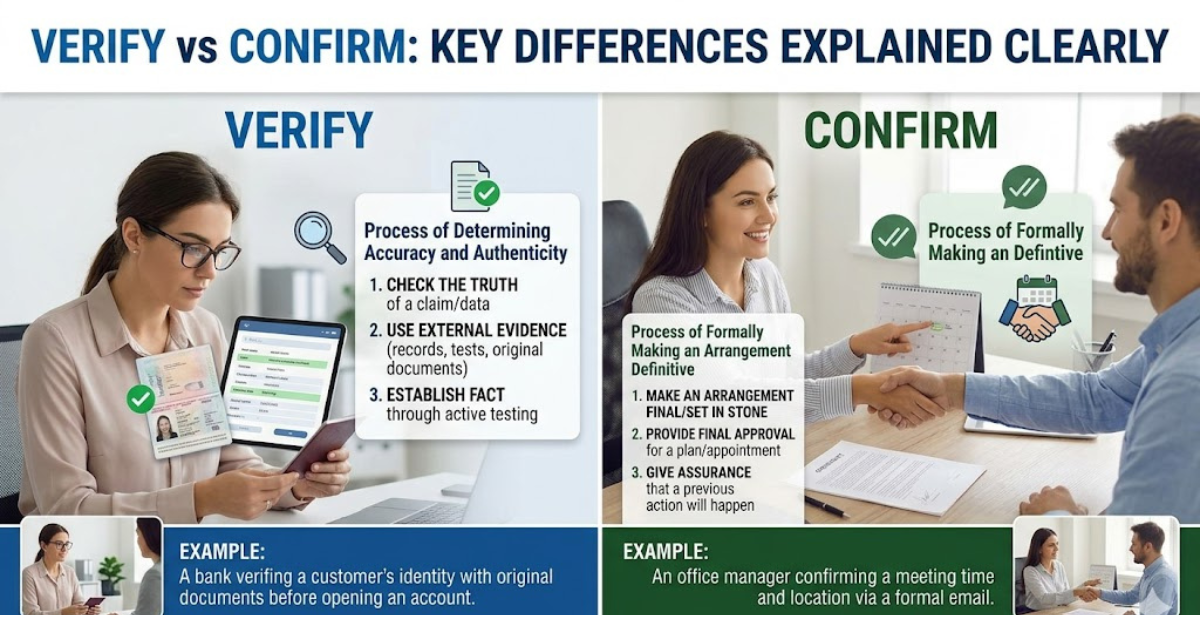
The word verify means to check or prove that something is accurate, true, or valid through evidence, investigation, or examination.
Verification usually involves gathering facts and assessing information before accepting it as correct.
Examples of Verification
- Verifying a customer’s identity before opening a bank account.
- Verifying the accuracy of data in a research study.
- Verifying an email address before sending important information.
- Verifying a news story through multiple sources.
In each case, evidence is required before the information can be trusted.
Key Characteristics of Verification
- Requires proof or evidence.
- Involves checking facts.
- Often includes research or investigation.
- Focuses on accuracy and authenticity.
What Does “Confirm” Mean?
The word confirm means to establish that something is true, correct, or agreed upon, often after receiving acknowledgment or additional information.
Confirmation generally occurs after information has already been presented and simply needs validation or agreement.
Examples of Confirmation
- Confirming a hotel reservation.
- Confirming attendance at a meeting.
- Confirming an appointment with a doctor.
- Confirming that a package was delivered.
Confirmation often involves receiving assurance rather than conducting an extensive investigation.
Key Characteristics of Confirmation
- Provides reassurance or validation.
- Often involves acknowledgment.
- Usually requires less investigation.
- Focuses on agreement or certainty.
Verify vs Confirm: The Main Difference
The simplest way to understand verify vs confirm is this:
Verification seeks proof. Confirmation provides assurance.
When you verify something, you’re checking whether it is true. When you confirm something, you’re acknowledging or validating information that is already believed to be true.
| Verify | Confirm |
| Checks accuracy through evidence | Validates or acknowledges information |
| Requires investigation | Requires assurance or agreement |
| Focuses on proving facts | Focuses on establishing certainty |
| Often occurs before acceptance | Often occurs after initial information is received |
When Should You Use “Verify”?
Use verify when accuracy matters and evidence is needed.
Common Situations for Verification
1. Identity Verification
Organizations often verify:
- Government-issued IDs
- Customer information
- Employment records
2. Fact-Checking
Journalists and researchers verify information by:
- Reviewing sources
- Examining evidence
- Comparing data
3. Technical Processes
In technology, verification may involve:
- Testing software functionality
- Verifying system configurations
- Checking database accuracy
When Should You Use “Confirm”?
Use confirm when you need reassurance, acknowledgment, or agreement.
Common Situations for Confirmation
1. Appointments
Businesses frequently ask customers to confirm:
- Medical appointments
- Interviews
- Reservations
2. Orders and Purchases
Companies confirm:
- Product orders
- Shipping details
- Payment receipt
3. Communication
People confirm:
- Meeting times
- Travel plans
- Event attendance
Verify vs Confirm in Business Communication
In professional environments, using the wrong term can create confusion.
Example 1
Incorrect:
“Please confirm the customer’s identity.”
Better:
“Please verify the customer’s identity.”
Identity requires evidence, so verification is appropriate.
Example 2
Incorrect:
“Please verify your attendance for tomorrow’s meeting.”
Better:
“Please confirm your attendance for tomorrow’s meeting.”
Attendance requires acknowledgment, not investigation.
Why This Matters
Using the correct term:
- Improves clarity.
- Reduces misunderstandings.
- Enhances professional communication.
- Demonstrates attention to detail.
Verify vs Confirm in Research and Science
The distinction becomes especially important in academic and scientific contexts.
Verification in Research
Researchers verify:
- Experimental results
- Data accuracy
- Measurement reliability
Verification ensures findings are supported by evidence.
Confirmation in Research
Confirmation occurs when:
- Results support a hypothesis.
- Independent studies produce similar outcomes.
- Findings align with expectations.
In science, verification and confirmation often work together but serve different purposes.
Verify vs Confirm in Technology
Technology professionals use these terms regularly.
Verification Examples
- Verify user credentials.
- Verify software installation.
- Verify data integrity.
Confirmation Examples
- Confirm account creation.
- Confirm password changes.
- Confirm transaction completion.
Understanding the distinction helps ensure accurate documentation and communication.
Common Synonyms for Verify and Confirm
Verify Synonyms
- Authenticate
- Validate
- Check
- Substantiate
- Prove
- Examine
Confirm Synonyms
- Approve
- Acknowledge
- Reinforce
- Corroborate
- Affirm
- Validate
While some overlap exists, context determines the best choice.
Easy Trick to Remember Verify vs Confirm
A simple memory aid:
Verify = Evidence
Ask yourself:
“Do I need proof?”
If yes, use verify.
Confirm = Certainty
Ask yourself:
“Do I need acknowledgment or reassurance?”
If yes, use confirm.
Common Mistakes People Make
Many people treat these terms as perfect synonyms, but that can lead to confusion.
Mistake #1: Confirming Facts That Need Proof
Instead of:
“Please confirm the authenticity of this document.”
Use:
“Please verify the authenticity of this document.”
Mistake #2: Verifying Attendance
Instead of:
“Please verify your attendance.”
Use:
“Please confirm your attendance.”
Mistake #3: Mixing Formal and Informal Usage
In casual conversation, the words may overlap. In professional settings, precision is more important.
Why Understanding Verify vs Confirm Matters
Knowing the difference between verify vs confirm offers several benefits:
- Improves writing accuracy.
- Enhances workplace communication.
- Prevents misunderstandings.
- Strengthens professional credibility.
- Supports clear documentation and reporting.
Whether you’re writing emails, conducting research, or managing customer interactions, choosing the right word can make your message more precise.
FAQs About Verify vs Confirm
Is verify the same as confirm?
No. Verification involves checking evidence to prove accuracy, while confirmation involves validating or acknowledging information that is already believed to be true.
Which comes first: verify or confirm?
Typically, verification comes first because information is checked for accuracy. Confirmation often follows once certainty has been established.
Can verify and confirm be used interchangeably?
Sometimes in casual conversation, but not always. In professional, legal, scientific, and technical contexts, the distinction is important.
What is an example of verify?
A bank verifying a customer’s identity using official documents is a common example of verification.
What is an example of confirm?
Replying to an email to confirm attendance at a meeting is a common example of confirmation.
Why do businesses use verification?
Businesses use verification to prevent fraud, ensure compliance, and maintain accurate records.
Conclusion
Understanding verify vs confirm is more than a vocabulary exercise—it’s an important communication skill. Verification focuses on proving accuracy through evidence, while confirmation centers on establishing certainty through acknowledgment or validation. Although the two terms are closely related, they serve different purposes in business, technology, research, and everyday conversations.
The next time you’re deciding between verify and confirm, remember this simple rule: verify when proof is needed, confirm when assurance is needed. Mastering this distinction will help you communicate more clearly and professionally in any situation.