English can be surprisingly tricky. Some words look similar, sound related, and seem interchangeable—until you use them in a sentence and realize something feels off. One common point of confusion is Freeze vs Froze. Many people hesitate when writing or speaking because both words come from the same verb, yet they work in different situations.
Understanding the difference is easier than it first appears. Once you know how verb tenses work, choosing the right word becomes almost automatic. This guide explains the meanings, grammar rules, examples, and common mistakes so you can use these words confidently in everyday conversations and writing.
Understanding Freeze and Froze
Both words come from the same base verb, but they belong to different verb forms.
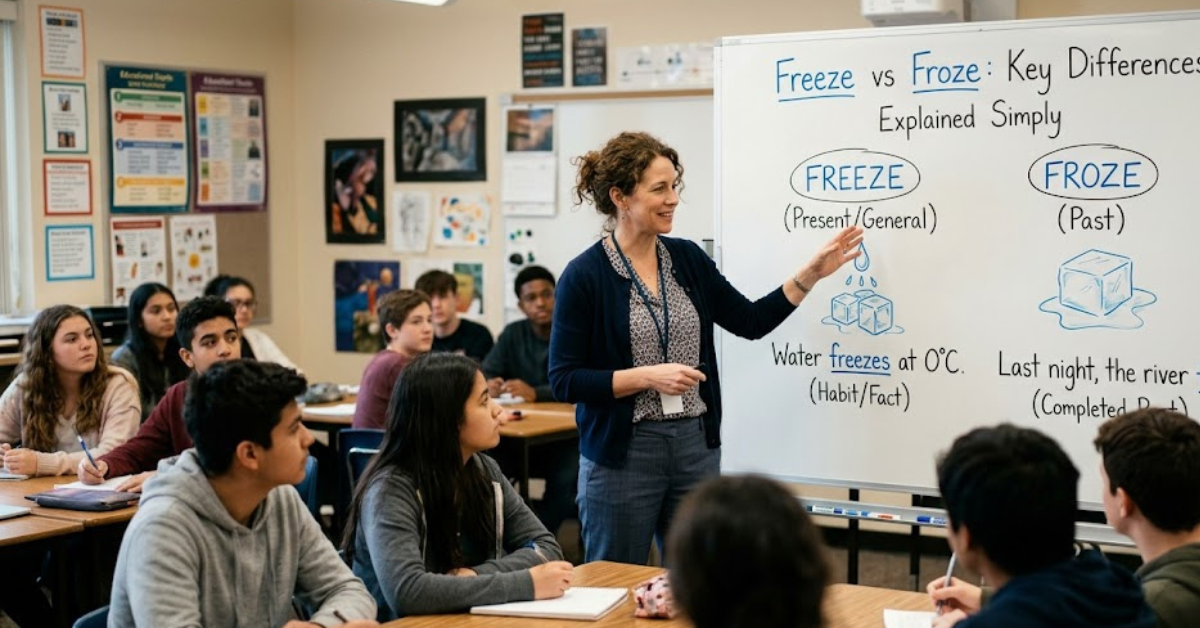
- Freeze = present tense form of the verb
- Froze = simple past tense form of the verb
The verb itself refers to becoming very cold, turning into ice, or stopping movement or action.
Examples:
Freeze (present tense)
- Water freezes at low temperatures.
- Please freeze the leftovers for tomorrow.
- I sometimes freeze when speaking in public.
Froze (past tense)
- The lake froze during winter.
- I froze when I heard the loud noise.
- The computer froze yesterday.
The difference mainly comes down to time.
What Does “Freeze” Mean?
“Freeze” is used when discussing something happening now, something that happens regularly, or something that will happen.
Common uses of freeze
1. Physical freezing
This refers to something becoming cold enough to turn solid.
Examples:
- The pipes may freeze overnight.
- Milk can freeze if stored improperly.
2. Emotional or physical reaction
People often use it when someone suddenly stops moving because of fear, shock, or nervousness.
Examples:
- I freeze whenever I have to speak on stage.
- Some people freeze during stressful situations.
3. Technology-related use
Modern language frequently uses the word when devices stop responding.
Examples:
- My phone tends to freeze after updates.
- The application may freeze if too many tabs are open.
What Does “Froze” Mean?
“Froze” simply shows that the action already happened.
Instead of something occurring now, it occurred earlier.
Examples:
- I froze while waiting outside in the snow.
- The river froze last winter.
- She froze for a moment before answering.
Notice that the action is completed.
Freeze vs Froze: The Main Difference
The easiest way to remember the distinction is to think about time.
Use freeze when:
- Talking about the present
- Describing habits
- Discussing future possibilities
Use froze when:
- Talking about completed past actions
- Referring to events that already happened
Consider these examples:
Present:
- Water freezes quickly in extreme temperatures.
Past:
- The water froze overnight.
Present:
- I freeze during job interviews.
Past:
- I froze during yesterday’s interview.
Common Grammar Forms Related to Freeze
English verbs often change depending on tense.
Here are the forms of the verb:
- Base verb: Freeze
- Past tense: Froze
- Past participle: Frozen
- Present participle: Freezing
Examples:
- I freeze leftovers every week.
- I froze the vegetables yesterday.
- The vegetables have frozen completely.
- The water is freezing.
Many people mistakenly use “froze” where “frozen” should appear.
Incorrect:
- The lake has froze.
Correct:
- The lake has frozen.
Common Mistakes People Make
Learning grammar becomes easier when you know what errors to avoid.
Using froze instead of frozen
Incorrect:
- My drink has froze.
Correct:
- My drink has frozen.
Using freeze for past events
Incorrect:
- Yesterday I freeze outside.
Correct:
- Yesterday I froze outside.
Forgetting context
Some people focus only on the word itself and ignore the sentence timeframe.
Ask yourself:
“When did the action happen?”
The answer usually tells you which word belongs there.
Easy Memory Tricks
Simple memory techniques can help the difference stick.
Remember the timeline
Think of it like this:
- Freeze = happening now
- Froze = already happened
Notice the vowel change
Many irregular verbs follow similar patterns:
- Speak → Spoke
- Break → Broke
- Freeze → Froze
This pattern can make the past tense easier to remember.
Real-Life Examples in Daily Conversations
Here are natural examples you might hear regularly:
At home:
- Can you freeze the extra food?
- The meat froze in the freezer.
At work:
- My screen tends to freeze during meetings.
- My laptop froze in the middle of the presentation.
Weather discussions:
- Rivers freeze during severe winters.
- The pond froze last night.
Why English Learners Often Get Confused
The confusion usually happens because English has many irregular verbs.
Unlike regular verbs that simply add “-ed,” irregular verbs change their spelling entirely.
Examples:
- Drive → Drove
- Write → Wrote
- Freeze → Froze
These changes don’t always follow predictable rules, which is why memorization and practice help.
FAQs
Is froze the same as frozen?
No. “Froze” is the simple past tense, while “frozen” is the past participle.
Example:
- I froze outside yesterday.
- I have frozen the food.
Can I say “has froze”?
No. The correct phrase is “has frozen.”
Incorrect:
- The water has froze.
Correct:
- The water has frozen.
Is freeze present tense?
Yes. It is the base and present-tense form of the verb.
Example:
- I freeze vegetables every week.
Why does my computer freeze?
In technology, the word means the device temporarily stops responding or functioning properly.
Is freeze an irregular verb?
Yes. It does not follow the normal “-ed” pattern.
Its forms are:
- Freeze
- Froze
- Frozen
Conclusion
Understanding Freeze vs Froze becomes much easier when you focus on verb tense rather than memorizing isolated words. “Freeze” refers to present or future situations, while “froze” points to something that already happened in the past. Knowing this distinction helps you avoid common grammar mistakes and communicate more naturally.
The next time you write or speak, pay attention to timing. A small change in tense can make a big difference in clarity and accuracy. Continue exploring grammar patterns and verb forms, and you’ll notice your confidence growing with every conversation.