Ever looked at the classroom clock and felt like the minute hand was stuck in slow motion? You’re not alone. For many students, long school days can feel endless, especially during boring lectures or repetitive routines.
Understanding how to make time go faster at school can completely change your experience of the day. It’s not about literally speeding up time—it’s about changing how your brain perceives it.
In this guide, you’ll learn practical psychology-based tricks, study strategies, and daily habits that make school feel less boring and much more manageable. These techniques are simple, realistic, and backed by how attention and memory actually work.
Why School Feels Slow The Psychology Behind It
Time perception isn’t fixed—it changes depending on how engaged your brain is. When you’re bored, your brain records more “time markers,” making minutes feel longer.
In contrast, when you’re focused or enjoying something, your brain compresses time. This is the core idea behind how to make time go faster at school: increase engagement so your mind stops tracking every second.
When attention is low, even a 45-minute class can feel like hours. But when you’re mentally involved, time seems to “skip ahead” without you noticing.
Break Your Day into Smaller Mental Blocks
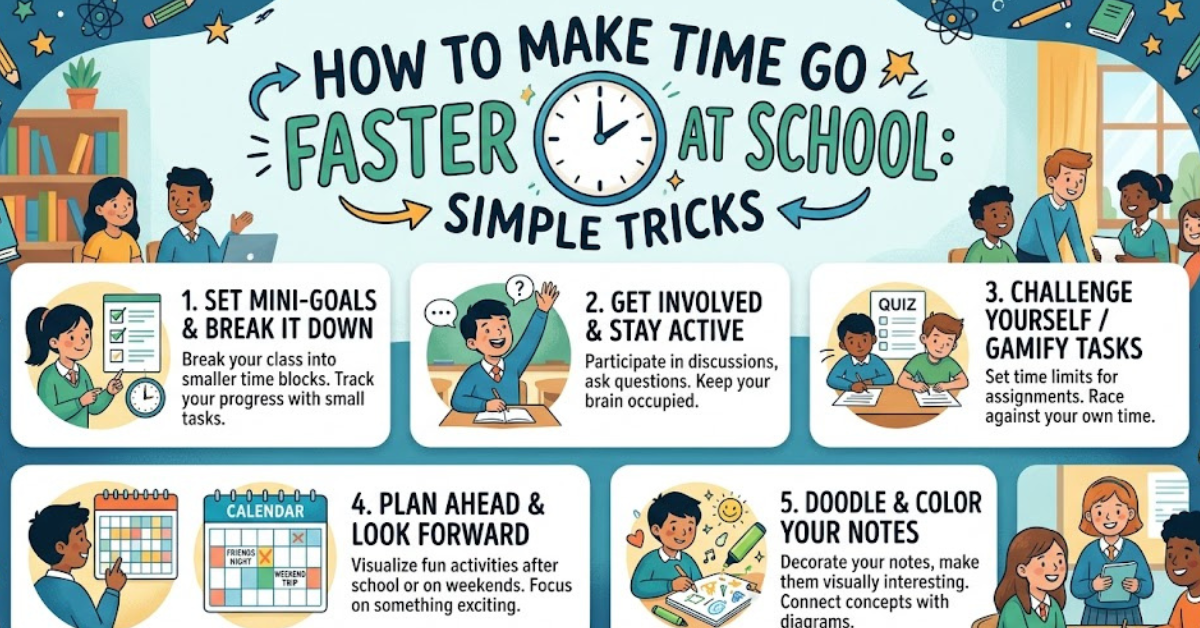
One of the most effective strategies for how to make time go faster at school is to mentally divide your day into short segments instead of one long stretch.
Instead of thinking:
“I still have 6 hours left”
Think:
“I just need to get through the next class”
This shift reduces mental pressure and makes the day feel more achievable.
Try this approach:
- Focus only on the current class, not the entire schedule
- Treat breaks as “mini rewards”
- Reset your mindset every period
When your brain stops viewing school as one long burden, time feels significantly faster.
Stay Actively Engaged in Class
Passive listening is one of the main reasons school feels slow. Active participation changes everything and is a key part of how to make time go faster at school.
Simple ways to stay engaged:
- Take detailed notes in your own words
- Ask yourself questions about the topic
- Try predicting what the teacher will say next
Even small mental involvement keeps your brain alert. The more engaged you are, the less your mind drifts—and the faster time seems to move.
Use Social Interaction to Speed Up Time
Talking to friends (at the right moments) can dramatically change your perception of time. Social interaction increases dopamine, which makes experiences feel quicker and more enjoyable.
This is another underrated method for how to make time go faster at school.
Smart ways to use it:
- Discuss lessons during group work
- Share quick jokes during breaks
- Study in pairs when allowed
Just be careful not to get distracted during important explanations. The goal is balance, not avoidance of learning.
Turn School Into a Game Productivity Hacks
Gamification is a powerful psychological trick. When tasks feel like a game, your brain becomes more engaged and less focused on time.
This is a highly effective approach to how to make time go faster at school.
Try gamifying your day:
- Set mini goals (e.g., “finish notes before class ends”)
- Reward yourself after completing tasks
- Compete silently with yourself (beat yesterday’s focus level)
By turning school into a challenge, you shift attention away from boredom and toward achievement.
Enter the “Flow State” for Faster Time Perception
Flow state is when you’re fully absorbed in what you’re doing. Athletes, artists, and gamers often experience it—and students can too.
Achieving flow is one of the most powerful methods for how to make time go faster at school.
How to trigger flow:
- Focus on one task at a time
- Avoid multitasking
- Stay slightly challenged but not overwhelmed
When you’re in flow, hours can feel like minutes. That’s the brain’s natural time distortion at work.
Avoid the Habits That Slow Time Down
Some behaviors make school feel painfully slow without you realizing it. If your goal is how to make time go faster at school, you need to minimize these:
- Constant clock-watching
- Daydreaming during lessons
- Sitting passively without engagement
- Overusing your phone during breaks
These habits increase boredom and make every minute feel stretched.
Replacing them with active attention is a game-changer.
Real-World Student Example
Consider two students in the same classroom:
- Student A stares at the clock, waiting for the bell
- Student B takes notes, asks questions, and chats during group work
At the end of the day, Student A feels exhausted and says school “dragged on forever.” Student B feels the day passed quickly.
The difference isn’t the schedule—it’s engagement. This is exactly what how to make time go faster at school is all about.
Key Takeaways
- Time feels slower when you’re bored and passive
- Engagement is the fastest way to change perception
- Breaking your day into segments reduces mental fatigue
- Social interaction and gamification help speed things up
- Avoid constant clock-watching and distraction loops
FAQ
1. Why does school feel so slow sometimes?
School feels slow because your brain tracks time more when you’re bored or unengaged. Lack of stimulation makes minutes feel longer.
2. What is the fastest way for how to make time go faster at school?
The quickest method is active engagement—take notes, participate, and stay mentally involved in the lesson.
3. Does listening to music help time pass faster at school?
It can help during breaks or independent work, but during lectures it may reduce focus. Balance is key.
4. Can friends really make school feel faster?
Yes, positive social interaction increases enjoyment and reduces focus on time, making the day feel shorter.
5. Is it normal for school to feel slow every day?
Yes, especially during repetitive routines. However, changing your engagement level can significantly improve perception.
6. How long does it take to change time perception in school?
You can notice changes almost immediately once you start applying attention and engagement techniques consistently.
Conclusion
Learning how to make time go faster at school isn’t about escaping class—it’s about changing how you experience it. When you stay engaged, break your day into smaller chunks, and use simple mental tricks, the entire school day feels lighter and more manageable.
You don’t need to overhaul everything at once. Even small changes in attention and behavior can make a noticeable difference. Try a few of these strategies tomorrow and see how your perception of time shifts.