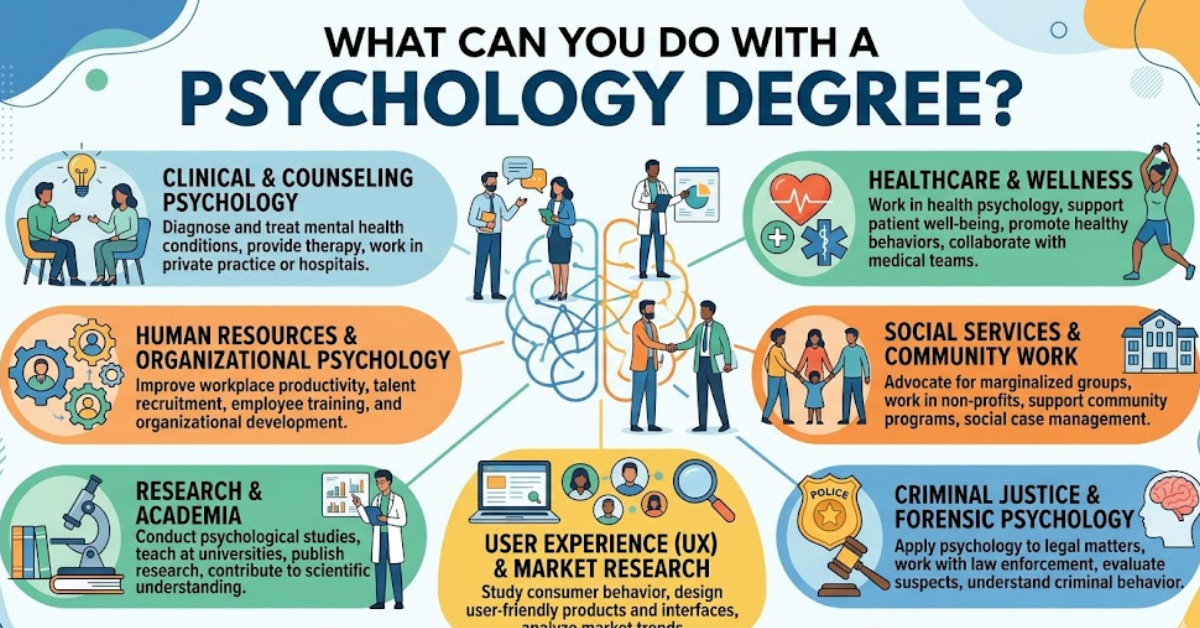
If you’ve ever wondered what can you do with a psychology degree, you’re not alone. Psychology is one of the most flexible and widely applicable fields of study, opening doors far beyond the therapy office. From business and education to law enforcement and healthcare, this degree builds strong skills in understanding human behavior, communication, and decision-making.
At its core, a psychology degree teaches you how people think, feel, and act—which is valuable in almost every industry today. Let’s break down the real-world career paths and opportunities you can explore.
Why a Psychology Degree Is So Versatile
A big reason people ask what can you do with a psychology degree is because the answer is surprisingly broad. Unlike highly specialized degrees, psychology blends science, critical thinking, and social understanding.
Key transferable skills include:
- Communication and interpersonal skills
- Data analysis and research methods
- Emotional intelligence
- Problem-solving and critical thinking
- Understanding human motivation and behavior
These skills are useful in nearly every workplace, which is why psychology graduates are found in so many industries.
Career Paths in Mental Health and Counseling
One of the most direct answers to what can you do with a psychology degree is working in mental health. While advanced roles require graduate study or licensing, a bachelor’s degree can still open entry-level positions.
Common roles include:
- Mental health technician
- Case manager assistant
- Psychiatric aide
- Rehabilitation support worker
If you continue your education, you can become:
- Clinical psychologist
- Licensed counselor
- Therapist
- Psychiatrist (with medical school)
This path is ideal for those passionate about helping people overcome emotional and psychological challenges.
Careers in Business and Marketing
Surprisingly, many psychology graduates end up in business settings. Companies value people who understand consumer behavior and decision-making.
Roles you might consider:
- Human resources specialist
- Marketing analyst
- Consumer behavior researcher
- Sales and customer relations manager
Businesses rely heavily on psychological principles to improve branding, advertising, and workplace productivity. Understanding what motivates people gives you a real competitive edge.
Psychology Degree Jobs in Education
If you’re still exploring what can you do with a psychology degree, education is another strong option.
Possible careers include:
- School counselor (with additional certification)
- Educational assistant
- Learning support specialist
- Youth program coordinator
Psychology graduates often work closely with students to support learning, behavior development, and emotional well-being. It’s a natural fit for those who enjoy mentoring and guiding others.
Criminal Justice and Forensic Psychology
Another fascinating direction is the criminal justice system. Psychology plays a major role in understanding criminal behavior, rehabilitation, and legal processes.
Career options:
- Probation officer
- Correctional treatment specialist
- Forensic psychology assistant
- Victim advocate
These roles focus on rehabilitation, risk assessment, and supporting both victims and offenders in the justice system.
Healthcare and Social Services Careers
A psychology degree also fits well within healthcare and community services. These roles focus on improving quality of life and supporting vulnerable populations.
Common jobs include:
- Social worker (with further study)
- Community support worker
- Behavioral health technician
- Substance abuse counselor assistant
This path is especially meaningful for those who want to work directly with people in need.
Research, Data, and Academic Careers
If you enjoy science and analysis, psychology offers strong research opportunities.
You might work as:
- Research assistant
- Data analyst (behavioral research)
- Lab coordinator
- Academic writer or educator
Psychology heavily relies on statistics and experiments, making it a strong foundation for data-driven careers.
Skills You Can Use in Any Industry
No matter which direction you choose after asking what can you do with a psychology degree, your skill set remains valuable everywhere.
Core strengths you gain:
- Understanding human behavior in real-life situations
- Interpreting data and research findings
- Managing communication in teams and organizations
- Recognizing emotional and cognitive patterns
These abilities are especially valuable in leadership and client-facing roles.
Do You Need a Master’s or PhD?
This is a common follow-up question when exploring what can you do with a psychology degree.
- Bachelor’s degree: Entry-level jobs in HR, marketing, social services, and support roles
- Master’s degree: Counseling, therapy, organizational psychology
- PhD/PsyD: Clinical psychologist, researcher, academic expert
Your career path depends on how far you want to specialize.
FAQs
1. What can you do with a psychology degree without further study?
You can work in HR, marketing, customer service, social services, and research assistant roles.
2. Is psychology a good degree for jobs?
Yes, it’s highly versatile and applicable in multiple industries, though advanced roles may require further education.
3. Can you become a therapist with just a psychology degree?
No. You typically need a master’s degree and licensing to become a practicing therapist.
4. What pays the most with a psychology degree?
Higher-paying roles include industrial-organizational psychology, clinical psychology, and corporate HR leadership positions.
5. Is psychology a hard degree?
It can be challenging due to its mix of science, statistics, and theory, but it’s manageable with consistent study.
Conclusion
So, what can you do with a psychology degree? The answer is: quite a lot more than most people expect. From mental health and education to business, law enforcement, and research, psychology opens doors across many industries.
The real strength of this degree lies in its flexibility. Whether you choose to continue studying or enter the workforce directly, you’ll carry skills that are relevant everywhere people are involved—which is almost everywhere.
If you’re exploring your next step, consider what environment fits your personality best, and build your path from there.