
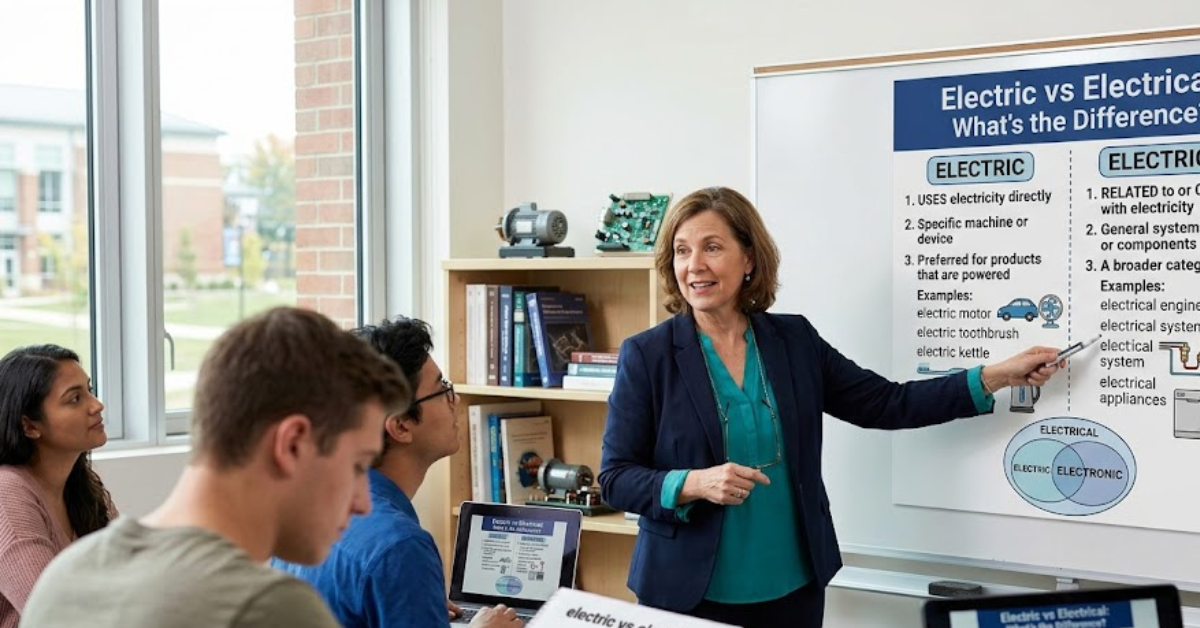
Have you ever wondered whether you should say electric car or electrical car? Or why people talk about electrical engineering but drive electric vehicles? The distinction may seem small, but understanding the difference can improve both your writing and communication.
The topic of electric vs electrical often confuses English learners, students, writers, and even native speakers. While both words relate to electricity, they are not always interchangeable. Knowing when to use each term can help you sound more accurate and professional.
In this guide, we’ll explore the meanings of electric and electrical, examine their differences, compare them with electronic devices, and answer some of the most common questions people have about these closely related terms.
Understanding the Meaning of Electric
The word electric typically describes something that operates using electricity, produces electricity, or is powered by electricity.
In simple terms, if an object uses electricity to function, there’s a good chance “electric” is the correct choice.
Examples of Electric
- Electric car
- Electric guitar
- Electric heater
- Electric scooter
- Electric toothbrush
In each case, the item relies on electrical power to perform its primary function.
When to Use Electric
Use “electric” when referring to:
- Devices powered by electricity
- Machines that run on electricity
- Things that generate electrical energy
- Effects caused directly by electricity
Example sentences:
- She bought an electric bicycle for commuting.
- The electric fan kept the room cool.
- Scientists developed a new electric motor.
Understanding the Meaning of Electrical
The word electrical generally refers to electricity itself, systems involving electricity, or the study and application of electrical power.
Rather than describing a powered device, it often describes a field, system, component, or concept connected to electricity.
Examples of Electrical
- Electrical engineering
- Electrical wiring
- Electrical circuit
- Electrical system
- Electrical maintenance
These terms focus on the infrastructure, science, or technical aspects of electricity rather than a specific powered product.
When to Use Electrical
Use “electrical” when talking about:
- Systems and networks
- Engineering disciplines
- Technical components
- Safety standards
- Electricity-related processes
Example sentences:
- The electrical wiring needs replacement.
- She studies electrical engineering at university.
- The technician inspected the electrical system.
Electric vs Electrical Difference Explained
The easiest way to understand the electric vs electrical difference is to focus on function.
Electric usually describes something that uses electricity.
Electrical usually describes something related to electricity as a subject, system, or field.
Consider these examples:
- Electric vehicle = a vehicle powered by electricity.
- Electrical system = the network that distributes electricity.
- Electric drill = a tool powered by electricity.
- Electrical wiring = the wires that carry electricity.
- Electric motor = a motor that runs on electricity.
- Electrical engineering = the engineering discipline dealing with electricity.
A useful rule of thumb is this:
If the item operates using electricity, choose “electric.” If it relates to electricity as a system or technical field, choose “electrical.”
Why Do People Confuse Electric and Electrical?
The confusion exists because both words originate from the same root and both relate to electricity.
In many situations, they appear very similar, and some phrases have evolved through common usage rather than strict grammatical rules.
For example:
- Electric train sounds natural.
- Electrical train sounds incorrect.
Meanwhile:
- Electrical engineer sounds natural.
- Electric engineer sounds incorrect.
The correct choice often depends on established usage patterns in English.
Cambridge Dictionary Electric vs Electrical
If you look at Cambridge Dictionary electric vs electrical definitions, you’ll notice a distinction similar to common usage.
Cambridge generally defines:
- Electric as powered by or producing electricity.
- Electrical as relating to electricity.
This difference aligns with how native speakers typically use the two terms in everyday communication.
For instance:
- Electric oven
- Electrical fault
One describes a powered appliance, while the other describes a problem involving an electrical system.
Merriam-Webster Electric vs Electrical
The Merriam-Webster electric vs electrical distinction follows a similar pattern.
According to standard dictionary usage:
- Electric often refers to something operated by electricity.
- Electrical refers more broadly to matters involving electricity.
The Merriam-Webster electric vs electrical difference highlights how electric is often more specific to devices, while electrical has a wider technical application.
This explains why we commonly say:
- Electric vehicle
- Electrical contractor
- Electric blanket
- Electrical equipment
Electronic vs Electric vs Electrical
One of the biggest sources of confusion is understanding electronic vs electric vs electrical terminology.
Although related, these words describe different concepts.
Electric
Refers to devices powered by electricity.
Examples:
- Electric scooter
- Electric kettle
- Electric fan
Electrical
Refers to systems, infrastructure, or the science of electricity.
Examples:
- Electrical engineering
- Electrical circuit
- Electrical installation
Electronic
Refers to devices that control electrical current using components such as microchips, transistors, or integrated circuits.
Examples:
- Electronic calculator
- Electronic watch
- Electronic computer
Quick Comparison
An electric heater converts electricity into heat.
An electrical system distributes electricity throughout a building.
An electronic device processes information using electronic circuits.
Understanding this distinction makes electric vs electrical vs electronic much easier to remember.
Common Examples in Everyday English
Here are some commonly used phrases and their correct forms.
Electric
- Electric car
- Electric bike
- Electric stove
- Electric razor
- Electric generator
Electrical
- Electrical engineer
- Electrical panel
- Electrical inspection
- Electrical repair
- Electrical code
Electronic
- Electronic device
- Electronic payment
- Electronic signature
- Electronic record
- Electronic communication
Common Mistakes to Avoid
Many learners make these errors:
Incorrect
- Electrical car
- Electrical toothbrush
- Electrical scooter
Correct
- Electric car
- Electric toothbrush
- Electric scooter
Another common mistake:
Incorrect
- Electric engineering
- Electric wiring system
Correct
- Electrical engineering
- Electrical wiring system
Learning these patterns helps you avoid awkward or unnatural phrasing.
Tips for Remembering the Difference
Here are three easy memory tricks:
1. Think About Power
If something runs on electricity, use “electric.”
Example:
- Electric vehicle
2. Think About Systems
If you’re discussing infrastructure or technical work, use “electrical.”
Example:
- Electrical installation
3. Think About Technology
If the device processes information through circuits or chips, use “electronic.”
Example:
- Electronic calculator
Electric vs Electrical Meaning in Professional Contexts
In technical industries, choosing the correct term matters.
For example:
- An electrical engineer designs and manages electrical systems.
- An electrician installs and repairs electrical components.
- A manufacturer may produce electric appliances for consumers.
Using the right terminology improves clarity in technical documents, academic writing, and workplace communication.
FAQs
What is the difference between electric and electrical?
Electric usually describes something powered by electricity, while electrical refers to systems, equipment, or concepts related to electricity.
Is an electric car or electrical car correct?
“Electric car” is correct because the vehicle runs on electricity.
Why is it called electrical engineering and not electric engineering?
The discipline studies electrical systems, circuits, and power distribution, making “electrical engineering” the standard term.
Is a computer electric or electronic?
A computer is primarily electronic because it uses microprocessors and electronic circuits to process information.
Can electric and electrical be used interchangeably?
Sometimes, but not always. Certain expressions have fixed usage in English, and substituting one for the other can sound unnatural.
What do dictionaries say about electric and electrical?
Both Cambridge and Merriam-Webster generally distinguish electric as powered by electricity and electrical as relating to electricity or electrical systems.
Conclusion
Understanding electric vs electrical is easier once you recognize the core distinction. Electric typically describes devices that operate using electricity, while electrical refers to systems, infrastructure, and concepts connected to electricity. When electronic devices enter the conversation, the distinction becomes even clearer because electronic equipment relies on advanced circuitry and information processing.
The next time you encounter phrases like electric vehicle, electrical wiring, or electronic device, you’ll know exactly why each term is used. Mastering these differences not only improves your English but also helps you communicate with greater accuracy in both everyday and professional settings.