Words that sound similar can create some surprisingly awkward mistakes. Imagine someone saying, “The children were gambling in the park,” when they actually meant they were running around and playing. That small spelling difference completely changes the meaning.
When discussing Gamble vs Gambol, confusion often happens because the two words look and sound alike. However, they belong in entirely different contexts. One is tied to risk and uncertainty, while the other is associated with playful movement and joyful activity. Understanding the distinction can instantly improve your vocabulary and help you avoid common language errors.
This guide breaks down both terms in a simple, practical way with examples, usage tips, and easy memory tricks.
What Does “Gamble” Mean?
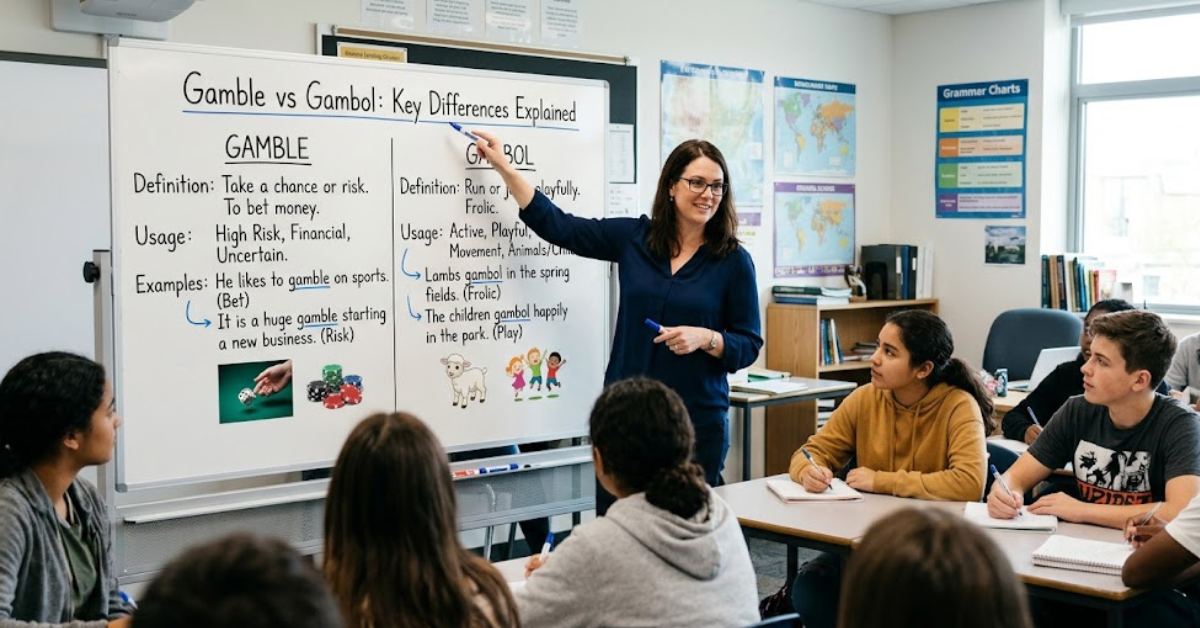
The word gamble refers to taking a risk with the hope of gaining something valuable. Most people connect it with betting money in casinos or games, but the word also appears in everyday situations.
A gamble can involve money, decisions, opportunities, or uncertain outcomes.
Examples:
- She decided to gamble on a new business idea.
- Buying stocks without research can be a gamble.
- They gambled at the casino all night.
In many situations, the word extends beyond money and describes calculated or even reckless risks.
Common Uses of Gamble
You will often see gamble used in these contexts:
- Financial risk
- Betting and gaming
- Business decisions
- Personal choices
- Investments
For example:
“Moving to a different city without a job offer was a gamble.”
The key idea is uncertainty combined with potential reward or loss.
What Does “Gambol” Mean?
Gambol has a much lighter and more cheerful meaning. It refers to skipping, jumping, or moving around playfully and energetically.
The word is often used for children and animals because it creates an image of carefree movement.
Examples:
- The puppies gamboled across the yard.
- Lambs gambol in fields during spring.
- The children gamboled around the playground.
Unlike gamble, there is no sense of danger or risk involved. The focus is entirely on joyful movement.
Common Uses of Gambol
You may encounter gambol in:
- Literature
- Nature writing
- Children’s stories
- Descriptions of playful behavior
Because it is somewhat literary, it appears less often in everyday conversation.
Gamble vs Gambol: Understanding the Core Difference
The easiest way to separate these words is by thinking about their central ideas.
Gamble = risk
Gambol = playfulness
Consider these examples:
Correct:
- He took a gamble by leaving his stable job.
- The young goats gambol around the hills.
Incorrect:
- The young goats gamble around the hills.
- She decided to gambol her savings on a business venture.
The meaning changes dramatically when the wrong word is used.
Quick Comparison Points
Here are the major distinctions:
Gamble
- Related to risk
- Often involves uncertain outcomes
- Can involve money or decisions
- Common in everyday language
Gambol
- Related to playful movement
- Describes energetic actions
- Frequently used for children and animals
- More common in literary writing
Why People Confuse These Words
Several reasons explain the confusion:
Similar Pronunciation
The two words sound alike, especially in fast speech.
Similar Spelling
Only one letter differs:
- Gamble
- Gambol
A small spelling variation can easily be overlooked.
Less Familiar Usage of Gambol
Most people hear gamble regularly through sports, business, and daily conversation. Gambol appears less frequently, making it easier to forget.
Memory Tricks to Remember the Difference
Simple memory techniques can help make the meanings stick.
Remember the “E” in Gamble
Think of:
E = Earnings or Economic risk
Gambling often involves money or potential gain.
Remember the “O” in Gambol
Think of:
O = Outdoor play
Children and animals often gambol outside.
These small associations can make the distinction easier to remember.
Examples in Everyday Sentences
Here are additional examples showing proper use.
Using gamble:
- Starting the company was a major gamble.
- He did not want to gamble his future.
- Investing without planning can be risky.
Using gambol:
- The kittens gamboled around the living room.
- Children gambol freely during recess.
- Young deer gambol through open fields.
Reading examples in context helps reinforce the difference.
Common Writing Mistakes to Avoid
Writers occasionally misuse these words because of spelling similarities.
Avoid these errors:
- Using gamble to describe playful activity
- Using gambol when discussing risk
- Assuming both words are interchangeable
A quick check of the sentence meaning usually solves the issue.
Ask yourself:
“Am I talking about risk or playful movement?”
The answer immediately points to the correct word.
Frequently Asked Questions
Is gambol the same as gamble?
No. Gamble means taking a risk, while gambol means moving or playing energetically.
Is gambol commonly used today?
Yes, although it is less common than gamble. It often appears in literature and descriptive writing.
Can gamble be used outside casinos?
Absolutely. People frequently use it for life decisions, business choices, and uncertain situations.
Is gambol mostly used for animals?
Not exclusively. It can describe children and people, but it is especially common when describing animals.
Which word is more common in daily speech?
Gamble is far more common because people regularly discuss risks, money, and decisions.
Conclusion
Understanding Gamble vs Gambol becomes simple once you focus on the main difference: one involves risk, and the other involves playful movement. Although the words look similar, they create entirely different meanings in a sentence.
Learning distinctions like these sharpens your communication and prevents common vocabulary mistakes. If you’re interested in improving your language skills further, explore similar word comparisons and continue building a stronger, more precise vocabulary.